Traffex 2027 | Theme 01 | Insight report
The Delivery
Gap
Closing the space between what's promised and what gets built.
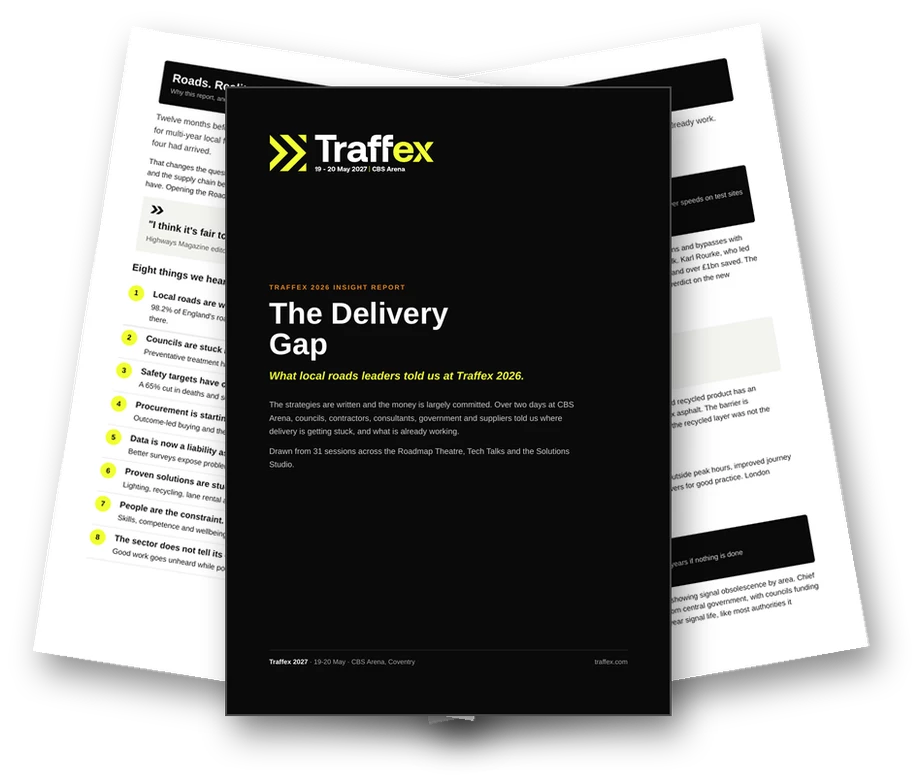
The strategies are written and the money is largely committed. At Traffex 2026, councils, contractors, consultants, government and suppliers told us where delivery is getting stuck on local roads, and what's already working.
"I think it's fair to say the government have done their job."
Highways Magazine editor, opening the Roadmap Theatre at Traffex 2026Eight things we heard
The question is no longer what government will do. It's whether the people running local roads, and the supply chain behind them, can turn strategy into delivery with the money, people and powers they have.
Local roads are where the gap is widest
98.2% of England's roads are run by local authorities, and most deaths and serious injuries happen there.
Councils are stuck in a reactive cycle
Preventative treatment has fallen from 7% of the network a year to 2%, and potholes are the result.
Safety targets have outrun capacity
A 65% cut in deaths and serious injuries by 2035 lands on teams that have lost experienced staff.
Procurement is starting to change
Outcome-led buying and the Procurement Act are opening doors for SMEs, but trials still stall.
Data is a liability as well as an asset
Better surveys expose problems councils cannot afford to fix overnight.
Proven solutions are stuck in pilots
Lighting, recycling, lane rental and signal renewal all have the evidence. Scale is the problem.
People are the constraint
Skills, competence and wellbeing came up in almost every session.
The sector doesn't tell its own story
Good work goes unheard while potholes and "war on the motorist" headlines dominate.
What's working
The fixes are already out there
Alongside the hard questions, speakers shared practical fixes that are already delivering on local roads. The report covers each one in detail.
"The right answer shouldn't have to wait for the process to catch up."
Ian Large, Head of Service, Highways and Traffic Management, Blackpool Council£6.7m a year for five years
Extra funding one council won by making a clear preventative maintenance case to members1% of the capital programme
What Reading Borough Council puts into innovation each year, turning successful trials into business as usual98% of works outside peak hours
On Transport for London's network, thanks to its lane rental schemeThe Delivery Gap at Traffex 2027
Where the conversation continues
The Delivery Gap puts funding, frameworks and delivery accountability in the same room. It covers RIS3 and funding, frameworks and procurement, devolution and major projects.
Example sessions
Example session
Opening Keynote: The Two-Tier Road Network
Example session
Framework Transparency
Example session
STARFour: A £350m SME Framework
Free download
Get The Delivery Gap insight report
Twelve pages drawn from 31 sessions at Traffex 2026:
- The strategy is set. Now it's over to the network.
- The maintenance trap
- Safety targets meet delivery capacity
- Buying differently
- Data that drives decisions
- Proven, but stuck in trials
- People: the real constraint
- The communications gap
- What to watch in 2027
Hear it from a council
Ian Large, Blackpool Council
Head of Highways and Traffic Management Services at Blackpool Council, filmed on the show floor at Traffex 2026.
Be part of the conversation in 2027.
Traffex 2027 brings together the councils, contractors, consultants, government bodies and suppliers working on local roads. Entry is free, and visitor registration opens on 1 February 2027.
Compiled by the Traffex team from recordings of sessions at Traffex 2026 (20-21 May 2026, CBS Arena, Coventry). Session figures are as presented by speakers. Local highway maintenance funding from the DfT's 2026 to 2030 allocations. Example sessions from the Traffex 2027 exhibitor brochure; full agenda to be announced.
